


The wounds of a decade-long war have never fully healed for thousands of conflict victims across Nepal. As the country moves through its transitional justice process, many survivors still carry unresolved trauma often without any access to the psychological support they need to recover, rebuild, and engage meaningfully with justice mechanisms as well as community.
The PCCITJ project is a joint initiative of CMC-Nepal and MANAS International Limited (UK), funded by the Swiss Agency for Development and Cooperation (SDC) through the Embassy of Switzerland in Nepal. It contributes to the goal of improving conflict victims’ psychosocial wellbeing through equitable access to quality MHPSS in the transitional justice process. The project is being implemented across 22 local levels in Sudurpaschim, Karnali and Lumbini Provinces, prioritizing communities with the highest concentrations of conflict-affected populations.
Context
Nepal’s armed conflict (1996–2006) left lasting psychosocial impacts on thousands of individuals and families. Many conflict victims continue to live with unresolved trauma and remain disconnected from the mental health and psychosocial support they need. As truth and reconciliation mechanisms take shape, ensuring that survivors can participate safely, with dignity, and with adequate support has become a matter of justice.
What We Do
PCCITJ supports to ensure that conflict victims receive accessible, quality, and culturally appropriate MHPSS before, during, and after their engagement in transitional justice processes. The project aims to deliver MHPSS service and TRC services through a survivor-centered and trauma-informed approach. It aims to reach people where they are, with care tailored to their individual needs, and with particular attention to those who are most marginalized across geography, gender, caste, and ethnicity.
The project looks beyond direct service delivery and works to embed MHPSS service within public health systems and transitional justice institutions building a sustainable and coordinated response that conflict-affected communities need.
What We Aim to Achieve
The project works toward three outcomes:
- Conflict victims demonstrate stable psychosocial health throughout their engagement with the transitional justice process.
- Local and provincial governments strengthen MHPSS policies and measures to promote the wellbeing and dignity of conflict victims, as envisioned by the TRC Act.
- Transitional justice commissions adopt trauma-informed and victim-centered approaches in their work.
PCCITJ recognizes that justice is not complete without healing. The project contributes to a transitional justice process that is not only more effective but more human by strengthening services, building institutional capacity, and keeping the voices and experiences of conflict victims at the center.
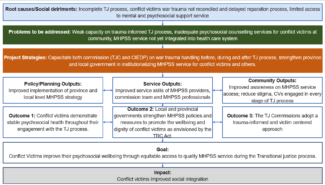
Figure1. Theory of Change